


Key differences between Project Management Office (PMO) and Project Manager (PM)
- Lorena Arteaga Valdez

- 24 oct. 2020
- 2 min de lecture
Managing a project is not an easy task, depending on its nature and complexity, the Project Management Framework must be tailored to meet the objectives. During the project management process, you must keep in mind two of the main actors, such as the PMO and PM, but it is key to understand that they have a different level of strategic management within the organization.
Project Management Office - PMO
One of the first things that you should be clear about is that the PMO is a department within the structure of the organization (the PMO is not just a person) and can take three different configurations depending on its level of power and involvement (Supportive, Controlling and Directive). In the following figure you can see how the level of power varies depending on the configuration, for more details on the different types of PMO, please check the previous article.

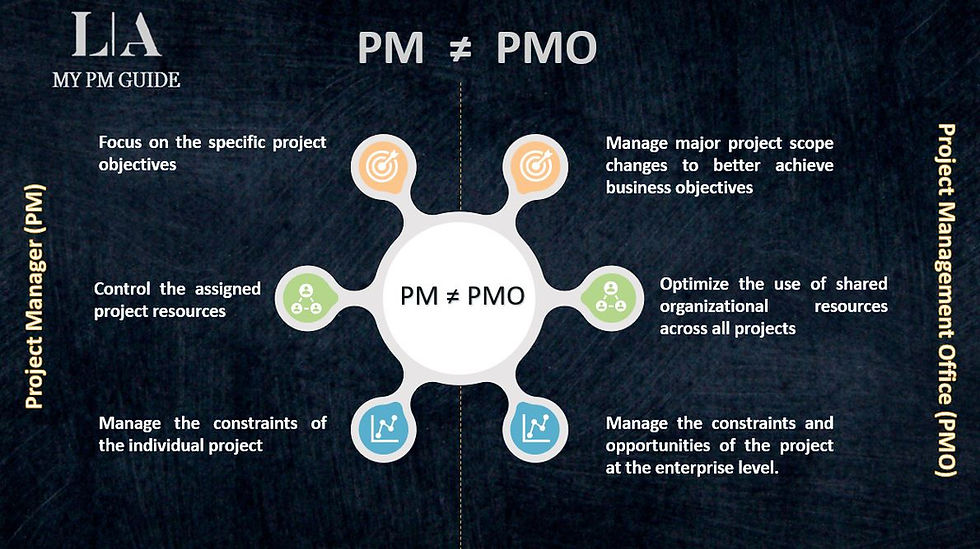
The PMO manages the interdependencies among projects, programs, and portfolios because it oversees the organization as a whole, setting the priority level of the different projects. It can also help to provide resources, templates, tools and techniques, training, recommendations based on project performance and it can suggest the termination of the project in case it is not relevant due to changes in the market, new regulations, etc.
Project Manager - PM
On the other, the PM is in fact one person, who has been authorized by a project charter to plan and execute the project and manage the assigned resources. The main target of the PM is to meet the specific project objectives within time, cost, and scope, but also considering quality aspects, risk, resources, and customer satisfaction.
The level of authority of the project manager will depend on the type of organizational structure.
Functional: here the organization is grouped by areas of specialization (e.g., Finance, Operations, Marketing, etc.). In this type of organization structure, the project occurs within the department and the Functional Manager has the level of authority.
Projectized: in this case, the organization is structured by projects, and therefore the Project Manager has control over the projects.
Matrix: this type of organization structures represents a balance between Functional and Projectized and it can be either weak or strong. In a weak matrix, the authority level is shared 50/50, while in a strong matrix, the Project Manager has control over the projects.
Were you familiar with these relevant aspects of the PMO and PM? If you have any other important aspect to highlight, please share it in the comment section below.
#projectmanagement#PMP#PMI#ProjectManager#Agile#leadership#motivation#careers#personaldevelopment#success#MyPMguide



Commentaires